 Renjiangenergy
Export tax rebates for photovoltaic products will be completely canceled starting from April 1

Against the background of accelerating global energy transformation, China’s photovoltaic industry has long dominated the global market by virtue of its complete industrial chain and scale advantages. In order to support the export of photovoltaic products, my country has implemented an export tax rebate policy and granted tax rebates of 13% to 15% to photovoltaic modules, cells and other products. However, with the expansion of industry production capacity and changes in the international trade environment, this policy will undergo major adjustments in 2025 – the Ministry of Finance announced that from April 1, 2025, export tax rebates for photovoltaic products will be completely cancelled, marking the official launch of the transformation of my country’s photovoltaic industry from “policy-driven” to “market-driven”.
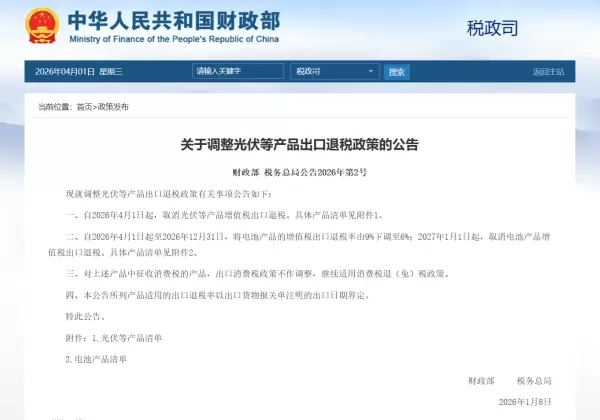
The cancellation of export tax rebates involves core products such as photovoltaic modules, cells, silicon wafers and inverters, and the tax rebate ratio will be returned to zero. According to calculations, based on the current average export price of photovoltaic modules of about US$0.15/watt, the cancellation of tax rebates will lead to an increase in corporate costs of about US$0.02/watt, which is equivalent to a 10%-15% reduction in profit margins. In the short term, export-oriented companies are facing rising cost pressures, and some small and medium-sized manufacturers may accelerate liquidation due to narrowing profits, and industry concentration will further increase. At the same time, price fluctuations may occur in the international market, and customers in major export destinations such as Europe and Southeast Asia may adjust their procurement strategies and require suppliers to share cost pressures. However, in the long term, policy adjustments will force companies to optimize cost structures, increase technology premiums, and promote the industry’s shift from “quantitative” expansion to “qualitative” upgrading.

As an industry leader, Renjiang Photovoltaic has a positive attitude towards policy adjustments. The company believes that although the cancellation of export tax rebates will increase cost pressure in the short term and may cause fluctuations in market demand, it will be conducive to the healthy and sustainable development of the industry. By eliminating inefficient production capacity and optimizing resource allocation, the industry will form a more reasonable competitive landscape. Renjiang Photovoltaic has formulated a systematic response strategy: On the research and development side, Renjiang Photovoltaic will use 3.5% of annual sales revenue as special research and development funds. In the next three years, it plans to establish 5-6 core technology research projects every year, develop more than 3 innovative products and apply for 4-5 patents; on the production side, flexible manufacturing technology is widely used in all aspects of product manufacturing, which can take care of customers’ personalized needs. While pursuing the goal, we will not sacrifice the advantages of production scale and quality control level. At the same time, we will reduce the failure rate, improve cost performance, and bring product performance and quality to the internationally advanced level. On the market side, the company will deepen cooperation with strategic customers in Europe, Southeast Asia and other places, and promote the global clean energy transformation from “product exports” to “technology + services” through co-building photovoltaic power stations and sharing technology benefits.